THIS WEEK IN CULTURE + THE CULTURE BUSINESS

Paul Herzberg: The Moth
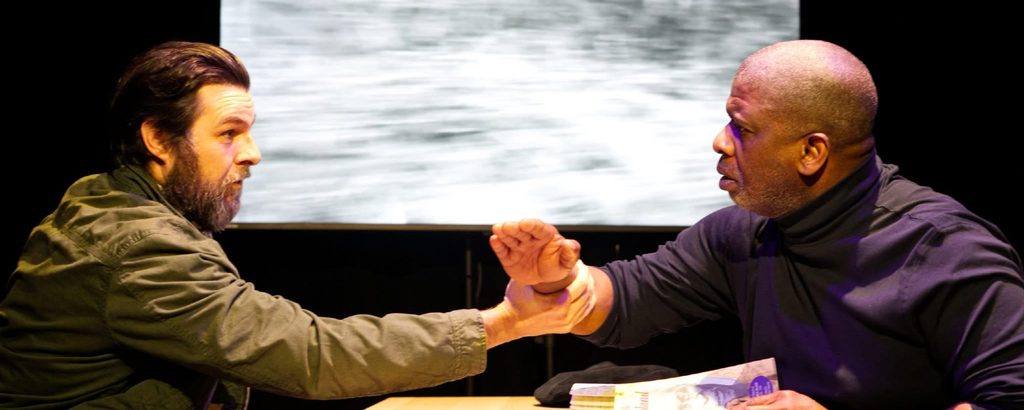
Coming up soon at the Finborough Theatre is the staging of a new play by prolific and multi-talented creative Paul Herzberg, who has expanded his award winning monologue ‘The Moth’, originally developed as a short film, into a two hander exploring forgiveness, racism and if we can escape the past.
Paul has had a successful career on stage and screen as both a performer and writer. I was really interested to hear more about that, as well as finding out all about this new work. I put some questions to him ahead of the upcoming run.
CM: Can you start by telling us a bit about the content of ‘The Moth’? Who is it about and where does the narrative take us?
PH: The play was developed from a short monologue commissioned by Jake Murray of Elysium Theatre Company, based on an anecdote told to me by an Angolan War veteran. The resulting film attracted 30,000 views online, was screened at numerous film festivals and won an award in New York.
A chance meeting on a train between John, a black British journalist, and Marius, a white South African ex-soldier, triggers an escalating chain of events that reshapes their lives over the next thirty years, as John withholds forgiveness and Marius becomes increasingly obsessed with seeking it.
At the heart of the story is a confession about a terrible event in the Angolan War that haunts Marius. The play is set in the present, in the UK, revisiting three explosive encounters between the two men that culminate in a showdown before the nation’s television cameras, as they face each other to lay bare their conflicting truths.
CM: What themes are explored through the play?
PH: At its heart, ‘The Moth’ explores forgiveness. Is it a religious construct? Who has the right to demand it or confer it, and what role does it play in human progress? Marius’s need for forgiveness confronts John’s refusal to grant it, exposing the difficult distinction between understanding a person and absolving them of responsibility.
The play also examines how racism continually reinvents itself, adapting to new circumstances and serving political ends. It explores how racial identities are constructed, how inherited beliefs shape our perceptions, and how injustice becomes embedded in the societies we create.
More fundamentally, ‘The Moth’ asks what happens when history gets inside us. We inherit the convictions and wounds of those who came before us, but are we condemned to repeat their mistakes? Can we escape the past without denying it – or becoming imprisoned by it?
CM: Does it have a message? Would you regard it as political?
PH: I offer no trite solutions. The play raises questions rather than seeking to deliver a message. We are living through an era of resurgent xenophobia, and the Angolan Border War and apartheid provide a bridge to the present.
The challenges we face as a global community may take different forms, but humanity has confronted them repeatedly.
So, yes, the play is political, but it is also a psychological thriller in which two men confront each other over the legacy of racism, responsibility for the past and whether forgiveness is ever possible.
CM: It’s inspired by a true event – how close to the truth would you say it is and how much of your own experience informs the play?
PH: The original anecdote was told to me while I was researching another project, but it stayed with me. It became the inspiration for a much larger story.
My own experience as a re-conscripted soldier in the South African Defence Force – the SADF – was essential to my ability to write that story authentically.
I did not serve on the front line myself, so I undertook extensive additional research into the role and experiences of someone like Marius, who, in the play, served in the SADF’s Special Forces.
Conscripted soldiers faced a grim choice: serve or go to jail. For those who refused to serve, the alternatives were imprisonment or leaving the country. After my time in the Angolan Border War, I chose the latter, making myself unavailable to the SADF.
CM: What inspired you to write about this? What made you want to create a piece of work focused on this?
PH: I had already written three plays about the military experience in South Africa.
My long absence from the country offered me a way, through ‘The Moth’, to bring my past bang up to the present and explore issues facing Britain and the wider world today.
I also wanted to explore political exile. Marius is not an exile in the conventional sense, but he remains consumed by the events of his past. John, by contrast, left his country as a small boy with his activist father, yet has been profoundly shaped by the events that followed.
Both men are scarred by the past in very different ways, and their differences come to a head in their final confrontation before the nation.
CM: As playwright, how involved have you been in this production?
PH: I attended the first few days of rehearsals for the Northern tour and will do the same for the Finborough production.
The play is being produced by my old friend Andy Jordan of AJP, and Jake’s company, Elysium. Because of that, I am happily drawn into all aspects of the show.
CM: Can you tell us a bit about the cast and the director?
PH: We have been blessed with two remarkable actors, both immensely talented and passionately committed to the play.
Many actors struggle to crack an Afrikaans accent – Micky Cochrane not only masters it convincingly but has the uncanny ability to convey menace and vulnerability simultaneously, exactly what the role of Marius demands. His performance earned him a North-East Culture Award.
Faz Singhateh similarly captures John as I imagined him, while bringing something more: a man of startling intellect, uncompromising views and the courage to defend them, yet deeply damaged by a traumatic youth as the son of an exiled South African activist, forced to live constantly on the move.
Jake Murray is a superb director, combining great finesse in working with actors with a profound understanding of text. We have enjoyed a long and wonderful collaboration.
He commissioned my original YouTube monologue, developed it with me and filmed it through his company, Elysium. When I proposed expanding it into a full-length play, he became its dramaturg.
CM: Can you tell us a bit more about you? What led you to a career in the arts? Was it what you always wanted to do?
PH: My late mother, a pioneering puppeteer in South Africa and an anti-apartheid activist, had a profound influence on me.
I initially trained at film school, considering a career as either an editor or screenwriter, before deciding to explore acting. I went on to study at the University Of Cape Town’s drama school.
In the early to mid-1970s, South Africa was an increasingly volatile place. I was drawn to The Space Theatre, founded by Brian Astbury, and performed in several productions there while still a student.
As the country’s first multiracial theatre, it defied the oppressive system under which we lived. Its courage and commitment to racial integration made a lasting impression on me.
I left South Africa in 1976 and retrained at LAMDA in London, subsequently establishing myself as an actor in the UK. In the mid-1980s, I began writing, and since then I’ve tried to balance the two disciplines, each informing and enriching the other.
CM: You’ve had an eclectic career both performing and writing for film, TV and theatre – has any one element been more satisfying to you?
PH: I find the two disciplines surprisingly similar, and I doubt I could have written the scripts I have without my training as an actor and my subsequent experience of performance. Each offers a different kind of satisfaction.
I remember the first night of ‘A Streetcar Named Desire’ as an actor and the extraordinary experience of seeing the play’s genius come alive in performance. There is something uniquely exciting about witnessing a work of such intelligence and power make its full impact on an audience.
Writing offers a different but equally powerful exhilaration: seeing a story you have created have a profound effect on an audience.
I felt this particularly strongly during the tour of ‘The Moth’, when audiences were eager to engage with the complex world of its two characters. The depth and intensity of the post-show discussions were immensely rewarding.
I wouldn’t say one discipline satisfies me more than the other. They feed into each other, and I feel fortunate to have been able to pursue both.
CM: What have been the highlights of your career thus far?
PH: Highlights include my early work at The Space; playing Stanley Kowalski in ‘A Streetcar Named Desire’ at the Mermaid; and performing in my own play ‘The Dead Wait’ at the Royal Exchange and the Park Theatre.
Also playing Shylock in ‘The Merchant Of Venice’ at the Arcola; and taking on two demanding roles in ‘Oslo’ at the National Theatre.
On television, highlights include ‘Smiley’s People’ with Alec Guinness, ‘The Life And Loves Of A She-Devil’, and more recently working with the remarkable Hugo Blick on ‘The Honourable Woman’ and ‘Black Earth Rising’.
As a writer, ‘The Dead Wait’ and ‘The Moth’ stand out.
CM: What aims and ambitions do you have for the future?
PH: To try and balance my professional life with spending as much time as I can with my two wonderful grandchildren.
‘The Moth’ is on at the Finborough Theatre from 27 Oct-21 Nov. For more information and to book tickets, see the venue website here.
LINKS: finboroughtheatre.co.uk | paulherzberg.com