THIS WEEK IN CULTURE + THE CULTURE BUSINESS

Tim Stubbs Hughes: Saving Myself
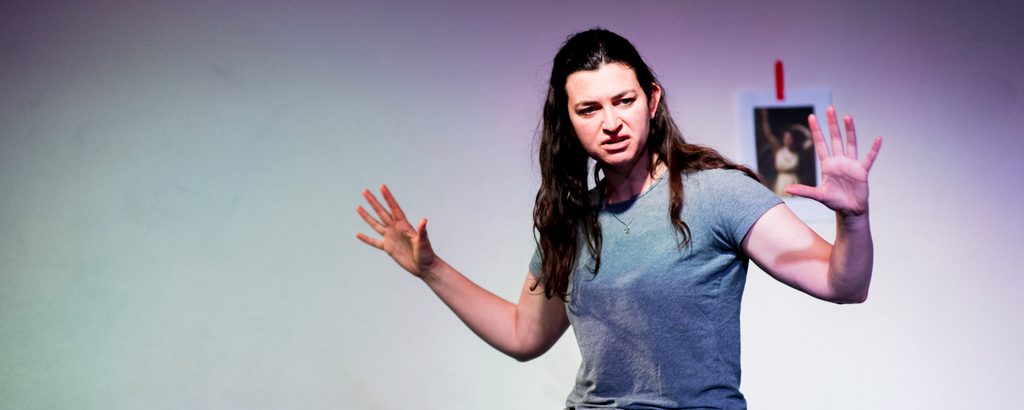
As you may be aware, Lambeth Fringe is currently up and running, and there’s a huge amount of brilliant creative stuff to take in.
One of the shows that we’re excited about is ‘Saving Myself’, a one woman show, written by Tim Stubbs Hughes, directed by Julia Stubbs and starring Jessamy James. It’s a play that’s already graced the Brighton and Camden Fringes, and with any luck, it will be appearing at another big festival before too long.
I spoke to playwright Tim ahead of the upcoming performance to find out more about the play and about the writer himself.
CM: Can you start by telling us a bit about the narrative of ‘Saving Myself’? Who is it about and where does the narrative take us?
TSH: ‘Saving Myself’ takes place over a single night and centres on Lilly, a young woman alone in her flat surrounded by books, fragments of paper, old stories and an unlit candle.
Since childhood, Lilly has somehow been made responsible when things go wrong. A pet disappears, something gets broken, there is an uncomfortable silence in the family. Gradually these incidents form a story about who Lilly is.
After she experiences a violent assault, those old ideas return with a new intensity. She begins to wonder whether there is really something wrong inside her: something inherited, something monstrous, perhaps something that has to be destroyed.
Over 45 minutes we follow her attempt to make sense of what has happened to her. The journey is partly psychological and partly almost ritualistic, as Lilly begins separating the stories other people have told about her from the story she might finally be able to tell about herself.
CM: What themes are explored through the play?
TSH: At its heart, I think the play is about shame, blame and ownership.
I’m interested in the stories people inherit about themselves and what happens when those stories become more powerful than their own experience. The psychologist Jessica Benjamin talks about ‘what you say about yourself and what others say about you’ as part of what forms your own identity.
Lilly has spent much of her life being interpreted by other people, so one of the central questions is whether she can reclaim the authority to say: this is what happened to me and this is what it means.
The play also explores trauma, misogyny and coercion, but alongside those things are folklore, superstition and the human need to create explanations for things we cannot understand.
There is a tension throughout between the rational and the mythical. Is Lilly haunted by something, or is the idea of being haunted simply the language she needs in order to understand something much more real?
CM: How would you describe it in terms of style or genre?
TSH: It’s a solo play which begins in something close to psychological realism but gradually moves into poetry, folklore and ritual.
I’ve never really thought of it as a straightforward monologue. Lilly is telling us a story, but she is also constructing something in the room. Objects begin to acquire meanings, memories repeat themselves and language becomes increasingly fragmented.
There is darkness in the play, but there is humour too. I think that was important. Lilly isn’t solemnly presenting her trauma to an audience; she is contradictory, sharp, difficult and sometimes very funny.
Stylistically, I wanted reality and myth to keep brushing against one another until we’re no longer entirely certain where one ends and the other begins.
CM: What was the inspiration for this? What made you want to write about this topic and themes?
TSH: The starting point was quite a simple question: what happens if someone is told the same story about themselves for long enough?
The piece started as a short fifteen minute response to a play at Theatre503 and their rapid response platform, and then developed from there. It became part of a scratch night performance with the theatre company What She Said Collective, and from there I developed it into its current format.
If you’re repeatedly told that you’re difficult, dangerous or somehow responsible when things go wrong, eventually you might start searching yourself for evidence that it’s true.
Asking this question led me towards folklore and particularly towards the historical ways we have explained behaviour and suffering that we don’t understand, whether its possession, curses, demons, witchcraft etc. Those ideas can seem very distant from us, but the instinct behind them isn’t necessarily distant at all.
I began thinking about a person trying to understand an experience of violence, but using this older, stranger language because ordinary language isn’t sufficient for her.
And from that, Lilly gradually appeared.
CM: Can you tell us about the director and performer? Were they involved with previous performances of the play? How did this creative team come together?
TSH: Julia Stubbs directs the production and Jessamy James plays Lilly, and they have both been with the show throughout its life so far.
They met through the scratch performance when it was a fifteen minute piece in November 2025, and through this interaction have been working on the piece since then. From its first performances at Brighton Fringe in May this year, through Camden Fringe in August, and now to Lambeth Fringe.
Julia and I have worked together in theatre for many years, so there is a great deal of trust between us. She is very rigorous about text, but she’s also interested in what an actor can discover beyond the words, which has been particularly important with this piece.
Jessamy brought something to Lilly that I couldn’t have written. A solo performance asks an enormous amount of an actor because there is nobody else on stage to pass the energy to.
She has gradually found all these different aspects of Lilly: the humour, the anger, the awkwardness, the vulnerability and the moments when she simply refuses to let the audience get any closer.
The performances at Brighton and Camden have therefore become part of the development process. We’ve learnt from watching how audiences respond and the production has subtly deepened each time we’ve returned to it.
CM: What made you decide to make it part of Lambeth Fringe and do you have hopes/plans for more performances in the future?
TSH: After Brighton and Camden, we wanted one more opportunity to bring the play to an audience this year, and Lambeth Fringe felt like a natural final chapter.
The Bread & Roses is also exactly the sort of intimate space where ‘Saving Myself’ works well. There is very little distance between Lilly and the audience and that proximity matters. At times you almost feel as though you’re sitting in the room with her rather than watching her from outside it.
So this is our final performance of 2026, but I don’t feel that it’s necessarily the end of the play. I want to push this play further, so in 2027 I am aiming for the Edinburgh Fringe – venues look out for my proposal! – and to also return the play to Brighton and Camden too.
CM: Can you tell us a bit about yourself now? How did you come to be writing, has this always been your aim?
TSH: No. I don’t think I ever saw myself as a writer.
I’ve spent most of my creative life somewhere around theatre. I originally trained in theatre, later studied directing, and for many years worked primarily as a director and producer.
Photography then became an increasingly important part of my practice and eventually another way of thinking about narrative, memory and how we frame experience. Writing arrived comparatively late.
But looking back, I realise I’ve probably always been interested in the same things: how we tell stories, what we choose to leave outside the frame, memory, identity and the gap between what happened and what we remember happening.
I began concentrating seriously on playwriting in the last few years when I undertook an MA in Photography at Falmouth University.
As part of the process we were asked to keep a blog about the course and our process, and from this experience of a daily practice, or continuing to put words down and examine what I was creating, the process of writing came about.
2026 has been an extraordinary step in that process because ‘Saving Myself’ became my first produced play and then ‘and I looked at the sky’ followed last month as my first full-length play.
I feel much more like I’m at the beginning of something than at the culmination of it.
CM: What aims and ambitions do you have for the future?
TSH: Primarily, I want to become a better writer and storyteller.
I’m interested in developing a body of work rather than chasing one particular kind of production. There are ideas and images that keep recurring for me, such as memory, landscape, ageing, grief, identity, people at moments of transition. I’d like the plays to begin speaking to one another over time.
I’m also interested in the relationship between writing and my photographic practice. They use very different languages, but increasingly I think they’re asking similar questions: what do we notice, what do we preserve, and what disappears when nobody is looking?
I’d like to continue developing work for intimate theatres while also giving myself permission to become formally more adventurous.
CM: What have been the highlights of your creative life thus far?
TSH: There have been several different creative lives, really.
I’ve had periods working as a theatre director and producer, periods when photography was at the centre of everything, and now this new period of writing.
But seeing words I’d written being spoken by actors for the first time has been significant. The first performance of ‘Saving Myself’ at Brighton Fringe was one of those moments. Something that had existed very privately suddenly belonged to Jessamy, Julia and an audience.
Then seeing ‘and I looked at the sky’ become a full production at Omnibus Theatre last month was another enormous step. It was a much larger piece, with Mary Tillett and John Rayment carrying these two people I’d lived with in my imagination for a long time.
All have created resonance. Resonance within me as I examine and witness what I see, and resonance within an audience who respond to the work.
Perhaps the real highlight is recognising, relatively late in my creative life, that there is still an enormous amount I don’t know how to do yet. I find that exciting.
CM: What’s coming up next for you after this?
TSH: The next play I’m developing is called ‘The Last Edge’.
It takes place in a house standing increasingly precariously on the edge of the Norfolk coast. Two brothers – or maybe two sisters, I haven’t decided yet – come together after the death of their mother. One stayed, caring for her and remaining in the family home, while the other left many years earlier and now lives abroad.
The land around the house is disappearing into the sea. Somewhere in the play is the ghost of King Canute.
I’m interested in the story we’ve created around Canute, which has become one about a king supposedly commanding the tide to stop, whereas the original idea is about recognising a person wanting to demonstrate to his supporters about the limits of human power. We cannot order the sea backwards.
So, the play is becoming about two kinds of erosion: the physical erosion of land and the slower erosion of family, memory and home. It is beginning to ask what we are trying to save when we say we want to save a place. And perhaps whether sometimes surviving means accepting that something cannot be saved.
It’s still at an early stage: a house, two siblings, a ghost and the sound of the sea getting closer.
‘Saving Myself’ is on at the Bread & Roses Theatre on 14 Oct, as part of Lambeth Fringe. Find more information about the show here.
LINKS: lambethfringe.com | timstubbshughes.co.uk